Super short review: A profound shrug.
Slightly longer review: Some fun dinosaur set-pieces, but bad human dialogue never sets up characters to care about.
Accurate tag line: Come see your favorite TV actors fight dinosaurs!
Most surprising cross-casting connection: Lauren Lapkus, formerly locking up humans in Orange is the New Black, is here locking up dinosaurs. In both, she has a boyfriend, thus stymying office romance.
Most retrograde gender politics: Oh my fucking god, women don't have to be mothers, jesus fucking christ. Seriously, most of the movie seems to be about punishing Bryce Dallas Howard until she gives up her job to take care of some kids who have very few redeeming qualities. Did you ever think you would miss Dr. Ian Malcolm hitting on Dr. Ellie Sattler?
Most baffling speech: B.D. Wong by a clear mile: in two successive lines he claims that this whole lab is only there because he's doing this work AND then he says that if he's not there, someone else will do this work instead. But that incoherence and muddiness of his character--that's not unique to him. All the characters are like that.
Most interesting coincidence (or not): a seven-year old came up with most of the best ideas in this movie many years ago! (Read this--and then subtract the Nazis part.)

Showing posts with label movies. Show all posts
Showing posts with label movies. Show all posts
Monday, June 15, 2015
Monday, June 1, 2015
Goonies, Godzilla
No great over-arching theme here, just two movies I saw recently and wanted to comment on:
Goonies
Like a lot of 80s kids, I have fond memories of this film. Actually, one of my fondest memories involves some friends when we were in college, appropriating the "This is our time, down here" line to claim the kitchen from my brother and his friends. Which is one way of saying: maybe you had to be there.
But if you watch this movie today, even with that veneer of nostalgia (Cyndi Lauper had a music video featuring this movie), there are a couple of things that are hard to take. They are easier to take when you watch the movie at the Alamo Drafthouse, at their Master Pancake event, which involves several comedians giving the movie a Mystery Science Theater treatment: commenting on and occasional cutting into the movie.
For instance, the opening, which involves a prison break, works hilariously well as a Wes Anderson film if you layer some Paul Simon over it.
Otherwise, a not so polished film from a not so polished era. Heck, even as a kid I recognized the shoddiness of the dad throwing paper into the air, followed by more paper being thrown into the air from behind.
Godzilla (2014)
I read that it got good reviews, that it nicely balanced human-size stories against giant monster fighting. I didn't really feel that. There were some fun moments and scares, like the time when the kids are on a school bus, waiting for something monstrous to happen, and--bang!--a bird hits the window.
But the human figures are all so bland, the scale of destruction is so boringly big, that there's very little human connection. And it tends to hit all of the beats for this sort of film, with the military doing things their way and eventually--finally!--listening to the scientist who was of course right.
(Of course, I prefer the scientist being right to the 1950s movies where the scientist could be the bad guy and the military was right. The Thing, I'm looking at you.)
Meanwhile, all the nuclear stuff just doesn't feel important these days. I know that's an essential part of the Godzilla mythos, so they couldn't really leave it out. But then why even remake Godzilla?
Goonies
Like a lot of 80s kids, I have fond memories of this film. Actually, one of my fondest memories involves some friends when we were in college, appropriating the "This is our time, down here" line to claim the kitchen from my brother and his friends. Which is one way of saying: maybe you had to be there.
But if you watch this movie today, even with that veneer of nostalgia (Cyndi Lauper had a music video featuring this movie), there are a couple of things that are hard to take. They are easier to take when you watch the movie at the Alamo Drafthouse, at their Master Pancake event, which involves several comedians giving the movie a Mystery Science Theater treatment: commenting on and occasional cutting into the movie.
For instance, the opening, which involves a prison break, works hilariously well as a Wes Anderson film if you layer some Paul Simon over it.
Otherwise, a not so polished film from a not so polished era. Heck, even as a kid I recognized the shoddiness of the dad throwing paper into the air, followed by more paper being thrown into the air from behind.
Godzilla (2014)
I read that it got good reviews, that it nicely balanced human-size stories against giant monster fighting. I didn't really feel that. There were some fun moments and scares, like the time when the kids are on a school bus, waiting for something monstrous to happen, and--bang!--a bird hits the window.
But the human figures are all so bland, the scale of destruction is so boringly big, that there's very little human connection. And it tends to hit all of the beats for this sort of film, with the military doing things their way and eventually--finally!--listening to the scientist who was of course right.
(Of course, I prefer the scientist being right to the 1950s movies where the scientist could be the bad guy and the military was right. The Thing, I'm looking at you.)
Meanwhile, all the nuclear stuff just doesn't feel important these days. I know that's an essential part of the Godzilla mythos, so they couldn't really leave it out. But then why even remake Godzilla?
Monday, May 25, 2015
Tomorrowland vs. The Gernsback Continuum vs. BioShock
It's hard to dislike Tomorrowland and its central message that imagination is a positive good--that thinking that some task is possible is better than thinking that all tasks are impossible.
It's hard to dislike that message and yet...
(Spoilers ahead.)
Getting out of the Gernsback Continuum
William Gibson's "The Gernsback Continuum" is a story that shadows Tomorrowland as a nightmare to a daydream: both focus on an alternate dimension where the 1950s dream of jetpacks and age-defying shakes is real. They're both rocket- or space-age dreams.
Gibson's genius in "The Gernsback Continuum" is to connect those rocket-dreams of what our future could've been both to the failures of that imagination (just about everyone is white and hetero in 1950s sf) and to the failures of our actual post-rocket time (where our rockets were pointed more at each other than at the moon).
Tomorrowland addresses this a bit, at least in the commercial for it, by presenting a multi-ethnic future; and by presenting our dreams of that Tomorrowland as an antidote to our obsession with our trending slide to dystopia and apocalypse.
But it doesn't all iron out, in the end. (Actually, the ethnic variations of the final recruiting scenes is pretty nicely done to remind us that Tomorrowland needs all kinds of people (even if all the lead actors that make it possible are white).)
The villain is appropriately named Nix, since nixing is the ultimate sin here, whether that's saying no to NASA funding or saying no to trying to change the world. He has one great monologue at the end where he points out that we enjoy apocalypse because it doesn't ask anything of us. (The fake movie billboard for "ToxiCosmos" bears the tagline "Nowhere to go," which lets us off the hook; it's almost like someone read Susan Sontag's "The Imagination of Disaster.") If nothing you do can help, than you can go on enjoying your rain forest-destroying burger and your conflict-mineral-related iPads.
(I would argue that the other great benefit of apocalypse is imagining a return to the Real: to that time when we're reduced to pure survival. I mean, in the apocalypse, I wouldn't be blogging and we can all get behind that.)
The heroes respond to this by saying, hey, let's try imagining progress rather than disaster. Which raises all sorts of questions that the movie can't ask: Whose progress? What sort of trade-offs are we willing to go through for this progress?
Let's have a utopia and inviteeveryone some people!
I also think BioShock might be instructive here (at least if you're interested in why I got some less-than-great vibes from this movie): BioShock is the great video game that showcased the art deco city of Rapture, a place where the elite could withdraw from the world to live out their Ayn Randian fantasy of self-fulfillment.
Which is kind of the end of Tomorrowland: they reopen the future and send out recruiters to find "dreamers." Among the dreamers are engineers, mathematicians, scientists, ballet dancers, street-artists--just a wide variety of people from the arts and sciences. (Notably missing: movie producers. Fuck those guys, am I right?)
And I'll admit, I got a little chill when I saw the last image of everyone, all together, standing up in the corn field and looking out at the city of tomorrow. All those people, all coming from their own particular places, all coming together to make something.
Except... there's like maybe a hundred people there. And that's the remit of Tomorrowland: it's not a place for everyone, but only for a small group who can work unencumbered by laws and social mores. (Hey, isn't Jurassic World about to come out? That's another story about people moving to a place to do something scientific.) Sure, maybe--maybe--the Tomorrowlanders will come back to Earth and share their great scientific advancements. Yeah, that's imaginable.
(What if they came back not as saviors but as technocratic rulers, with disintegration rays and robot armies and--but no, that's the bad imagination speaking.)
This is another aspect of the movie that leaves me wanting more answers; and it connects to the original question: if you limit your society to just the people who pass the test (not the Voight-Kampff, because that would prove empathy and that's not what Tomorrowland is about), then you can maybe all agree on what sort of progress you want.
Or put in question form: is progress compatible with democracy?
(You know who would say no to that? The 1930s Technocracy movement that seems to cast a long shadow over a lot of 1950s sf, where slide-rule-bearing engineers are clearly the right men for the job of making the rules.)
It's hard to dislike that message and yet...
(Spoilers ahead.)
Getting out of the Gernsback Continuum
William Gibson's "The Gernsback Continuum" is a story that shadows Tomorrowland as a nightmare to a daydream: both focus on an alternate dimension where the 1950s dream of jetpacks and age-defying shakes is real. They're both rocket- or space-age dreams.
Gibson's genius in "The Gernsback Continuum" is to connect those rocket-dreams of what our future could've been both to the failures of that imagination (just about everyone is white and hetero in 1950s sf) and to the failures of our actual post-rocket time (where our rockets were pointed more at each other than at the moon).
Tomorrowland addresses this a bit, at least in the commercial for it, by presenting a multi-ethnic future; and by presenting our dreams of that Tomorrowland as an antidote to our obsession with our trending slide to dystopia and apocalypse.
But it doesn't all iron out, in the end. (Actually, the ethnic variations of the final recruiting scenes is pretty nicely done to remind us that Tomorrowland needs all kinds of people (even if all the lead actors that make it possible are white).)
The villain is appropriately named Nix, since nixing is the ultimate sin here, whether that's saying no to NASA funding or saying no to trying to change the world. He has one great monologue at the end where he points out that we enjoy apocalypse because it doesn't ask anything of us. (The fake movie billboard for "ToxiCosmos" bears the tagline "Nowhere to go," which lets us off the hook; it's almost like someone read Susan Sontag's "The Imagination of Disaster.") If nothing you do can help, than you can go on enjoying your rain forest-destroying burger and your conflict-mineral-related iPads.
(I would argue that the other great benefit of apocalypse is imagining a return to the Real: to that time when we're reduced to pure survival. I mean, in the apocalypse, I wouldn't be blogging and we can all get behind that.)
The heroes respond to this by saying, hey, let's try imagining progress rather than disaster. Which raises all sorts of questions that the movie can't ask: Whose progress? What sort of trade-offs are we willing to go through for this progress?
Let's have a utopia and invite
I also think BioShock might be instructive here (at least if you're interested in why I got some less-than-great vibes from this movie): BioShock is the great video game that showcased the art deco city of Rapture, a place where the elite could withdraw from the world to live out their Ayn Randian fantasy of self-fulfillment.
Which is kind of the end of Tomorrowland: they reopen the future and send out recruiters to find "dreamers." Among the dreamers are engineers, mathematicians, scientists, ballet dancers, street-artists--just a wide variety of people from the arts and sciences. (Notably missing: movie producers. Fuck those guys, am I right?)
And I'll admit, I got a little chill when I saw the last image of everyone, all together, standing up in the corn field and looking out at the city of tomorrow. All those people, all coming from their own particular places, all coming together to make something.
Except... there's like maybe a hundred people there. And that's the remit of Tomorrowland: it's not a place for everyone, but only for a small group who can work unencumbered by laws and social mores. (Hey, isn't Jurassic World about to come out? That's another story about people moving to a place to do something scientific.) Sure, maybe--maybe--the Tomorrowlanders will come back to Earth and share their great scientific advancements. Yeah, that's imaginable.
(What if they came back not as saviors but as technocratic rulers, with disintegration rays and robot armies and--but no, that's the bad imagination speaking.)
This is another aspect of the movie that leaves me wanting more answers; and it connects to the original question: if you limit your society to just the people who pass the test (not the Voight-Kampff, because that would prove empathy and that's not what Tomorrowland is about), then you can maybe all agree on what sort of progress you want.
Or put in question form: is progress compatible with democracy?
(You know who would say no to that? The 1930s Technocracy movement that seems to cast a long shadow over a lot of 1950s sf, where slide-rule-bearing engineers are clearly the right men for the job of making the rules.)
Monday, March 9, 2015
Robocop, How I Would Write It
The Brilliant Very Good Original
Robocop is not my favorite Verhoeven film, but it's a film I like a lot: you can watch it naively as a simple tale of man vs. machine, of the corrupting influence of capitalism, of--Wait, did I say that was the naive way to watch it? Let's start over.
Here's a classic, simple tale: a man falls into some pit, but then crawls his way back up. We cheer. That pit takes many forms, whether it's an internal character flaw (like greed or anger) or an external situation (like... a pit).
At its most basic, Verhoeven's Robocop is a pit story: a man falls into a pit--cop Murphy gets shot up and then re-made as a cyborg without a name, a cog in a corporate machine who can't even do his job (arrest criminals) because of corporate corruption; but by the end, that cyborg cop (OK, fine: robocop) crawls his way out of the pit, reclaiming his name and his humanity.
(Also, getting his vengeance, the classic American story of regeneration through revenge.)
(Also also: his revenge is entirely mediated by the corporate structure since he only takes revenge on the corporate criminal when that guy gets fired by someone even higher up on the corporate food-chain. But for a moment, pretend this paragraph doesn't exist.)
So, it's a fine story at the man-vs-pit level.
On top of that, screenwriters Edward Neumeier and Michael Miner build a story about unrestrained capitalism, which reaches its apotheosis in the owning of people, either in the form of addiction (the drug trade is the highest form of consumerism here) or in the literal owning of people's bodies (as with Murphy being property).
And then, on top of that, Verhoeven adds (or embraces) a certain tone of louche skepticism. I'm not entirely sure what I mean by "louche skepticism," but I like it as a phrase. No, I do know what I mean: as friend Jason points out in his blog post, Verhoeven makes everything so gloriously over-the-top that it's hard to miss the satire here.
(Then again, when Starship Troopers came out, I said the same thing--and lots of people missed it.)
But really, when a drug-dealer comments on how drug-dealing is the highest form of capitalism, there's not a lot of subtext going on there. At that point, it's just text.
The Rather Hollow Remake
I just finished the remake and... I'm not really sure I could tell you what it's about. There's Alex Murphy, who, again, is a good cop turned into a product. There's the big corporation that makes robots/drones for war overseas and wants to start using them here. There's the blow-hard TV personality with a definite bias. There's the doctor with the heart of gold. There's the widow/wife and the partner of Alex-cum-RoboCop. There's some of the same goddamn lines, like "Dead or alive, you're coming with me."
And about that particular line: goddamn it, people, in the original that line was a way to show that RoboCop retained some of Murphy's personality, which was a little cowboyish (That line and the gun-twirling are both used as proof that RoboCop was Murphy; and as proof that Murphy is an old-style American, a no-nonsense frontier-tamer. That description comes with a big old wink by Verhoeven.) In the 2014 version, that line is repurposed--Murphy is now describing himself as "Dead or alive" as opposed to describing the criminal--which is cute, but has no real purpose other than to remind the audience that this is a reboot. It doesn't add up to anything.
That's the big problem with the remake: it's flashier than the original, but there's a certain sense of hollowness here.
Fix It,Felix Ben!
RoboCop in 1987 was science fiction satire, with deadly robots and private cops and corporate crime. In 2014, we call that reality.

So why remake RoboCop? How can the general frame of this story--man vs. corporate machine that he's become--help tell a good story, illuminate our moment, and, oh yeah, make a killing at the box office?
(RoboCop 2014 was made for 100-130$ and made 240$, which is respectable, around 200% return. RoboCop 1987 was made for 13$ and made 54$--a 400% return. Which would you rather have?)
First, screw all that ridiculousness about the political opponents of the robots having power. It generates some motivation for the corporation to use RoboCop as a mascot, but it waters down the real conflict. Ditto the media issue with Samuel L. Jackson's TV blowhard: it's not that interesting because it doesn't tell us anything we don't know about the world or take the story anywhere new.
Second, corrupt cops are boring; a broken policing system is interesting. (Did we learn nothing from The Wire?)
Third, what's interesting about this story to you (screenwriter, director, producer)? Verhoeven's RobcCop is clearly Verhoeven's work: the story may be pretty ordinary man-and-his-pit core, but there's all of Verhoeven's usual issues on top of it.
RoboCop 2014 could almost be the work of anyone because there's nothing that really distinguishes it; it's a little bloodless. If you're going to remake a movie, make it something you're interested in.
(Hollow, bloodless--thanks, filmmakers, for making a movie where the central metaphor maps perfectly onto the critique of the film.)
My RoboCop
I'm not going to write a reboot of RoboCop 1987 (and this post is already way too long), but here's some things I would want to think about going in to write or pitch on this project:
There's a couple different ways to go with this constellation of issues. (And you might disagree that these are, in fact, the useful issues to be discussing; in which case, please tell me about your version of RoboCop.) But at its heart, RoboCop is a man-vs-pit story, where that pit tends to be marked as corporate capitalist organizations, like drug cartels and corporations. It's about a man regaining a sense of self through fighting a conspiracy. It's an underdog story (with a massively armed and armored underdog).
So here's one version: I call it, A Boy and his RoboCop.
The military-industrial complex keeps pumping out drones for war overseas; and then needing to dump the older models so they can keep pumping out newer versions. As in our world, this ex-military gear finds its way into the hands of the police forces--and maybe the criminals. (Though as we've seen, arming the police is pretty terrifying all by itself.) A damaged police drone starts acting erratically, going AWOL to discover its original home, now occupied by a small homeless child who might or might not be the child of the drone's original brain. Ah, because (dun dun dun) these drones are built around dead veterans. Something something apathetic cop, good cop, damaged cop.
(Note: this wouldn't work as a RoboCop pitch since, going into RoboCop, the audience knows that he's man and machine. So we couldn't have that "human brain in a jar" as a revelation. Still, I'd rather watch this movie than the one I did watch.)
Robocop is not my favorite Verhoeven film, but it's a film I like a lot: you can watch it naively as a simple tale of man vs. machine, of the corrupting influence of capitalism, of--Wait, did I say that was the naive way to watch it? Let's start over.
Here's a classic, simple tale: a man falls into some pit, but then crawls his way back up. We cheer. That pit takes many forms, whether it's an internal character flaw (like greed or anger) or an external situation (like... a pit).
At its most basic, Verhoeven's Robocop is a pit story: a man falls into a pit--cop Murphy gets shot up and then re-made as a cyborg without a name, a cog in a corporate machine who can't even do his job (arrest criminals) because of corporate corruption; but by the end, that cyborg cop (OK, fine: robocop) crawls his way out of the pit, reclaiming his name and his humanity.
(Also, getting his vengeance, the classic American story of regeneration through revenge.)
(Also also: his revenge is entirely mediated by the corporate structure since he only takes revenge on the corporate criminal when that guy gets fired by someone even higher up on the corporate food-chain. But for a moment, pretend this paragraph doesn't exist.)
So, it's a fine story at the man-vs-pit level.
On top of that, screenwriters Edward Neumeier and Michael Miner build a story about unrestrained capitalism, which reaches its apotheosis in the owning of people, either in the form of addiction (the drug trade is the highest form of consumerism here) or in the literal owning of people's bodies (as with Murphy being property).
And then, on top of that, Verhoeven adds (or embraces) a certain tone of louche skepticism. I'm not entirely sure what I mean by "louche skepticism," but I like it as a phrase. No, I do know what I mean: as friend Jason points out in his blog post, Verhoeven makes everything so gloriously over-the-top that it's hard to miss the satire here.
(Then again, when Starship Troopers came out, I said the same thing--and lots of people missed it.)
But really, when a drug-dealer comments on how drug-dealing is the highest form of capitalism, there's not a lot of subtext going on there. At that point, it's just text.
The Rather Hollow Remake
I just finished the remake and... I'm not really sure I could tell you what it's about. There's Alex Murphy, who, again, is a good cop turned into a product. There's the big corporation that makes robots/drones for war overseas and wants to start using them here. There's the blow-hard TV personality with a definite bias. There's the doctor with the heart of gold. There's the widow/wife and the partner of Alex-cum-RoboCop. There's some of the same goddamn lines, like "Dead or alive, you're coming with me."
And about that particular line: goddamn it, people, in the original that line was a way to show that RoboCop retained some of Murphy's personality, which was a little cowboyish (That line and the gun-twirling are both used as proof that RoboCop was Murphy; and as proof that Murphy is an old-style American, a no-nonsense frontier-tamer. That description comes with a big old wink by Verhoeven.) In the 2014 version, that line is repurposed--Murphy is now describing himself as "Dead or alive" as opposed to describing the criminal--which is cute, but has no real purpose other than to remind the audience that this is a reboot. It doesn't add up to anything.
That's the big problem with the remake: it's flashier than the original, but there's a certain sense of hollowness here.
Fix It,
RoboCop in 1987 was science fiction satire, with deadly robots and private cops and corporate crime. In 2014, we call that reality.
So why remake RoboCop? How can the general frame of this story--man vs. corporate machine that he's become--help tell a good story, illuminate our moment, and, oh yeah, make a killing at the box office?
(RoboCop 2014 was made for 100-130$ and made 240$, which is respectable, around 200% return. RoboCop 1987 was made for 13$ and made 54$--a 400% return. Which would you rather have?)
First, screw all that ridiculousness about the political opponents of the robots having power. It generates some motivation for the corporation to use RoboCop as a mascot, but it waters down the real conflict. Ditto the media issue with Samuel L. Jackson's TV blowhard: it's not that interesting because it doesn't tell us anything we don't know about the world or take the story anywhere new.
Second, corrupt cops are boring; a broken policing system is interesting. (Did we learn nothing from The Wire?)
Third, what's interesting about this story to you (screenwriter, director, producer)? Verhoeven's RobcCop is clearly Verhoeven's work: the story may be pretty ordinary man-and-his-pit core, but there's all of Verhoeven's usual issues on top of it.
RoboCop 2014 could almost be the work of anyone because there's nothing that really distinguishes it; it's a little bloodless. If you're going to remake a movie, make it something you're interested in.
(Hollow, bloodless--thanks, filmmakers, for making a movie where the central metaphor maps perfectly onto the critique of the film.)
My RoboCop
I'm not going to write a reboot of RoboCop 1987 (and this post is already way too long), but here's some things I would want to think about going in to write or pitch on this project:
- corporations and patent-trolling;
- intellectual property;
- race-class inequality in policing;
- drones and the psychological cost of distant war;
- augmented reality and tech popularity;
- corporate-political cooperation;
- neverending war.
There's a couple different ways to go with this constellation of issues. (And you might disagree that these are, in fact, the useful issues to be discussing; in which case, please tell me about your version of RoboCop.) But at its heart, RoboCop is a man-vs-pit story, where that pit tends to be marked as corporate capitalist organizations, like drug cartels and corporations. It's about a man regaining a sense of self through fighting a conspiracy. It's an underdog story (with a massively armed and armored underdog).
So here's one version: I call it, A Boy and his RoboCop.
The military-industrial complex keeps pumping out drones for war overseas; and then needing to dump the older models so they can keep pumping out newer versions. As in our world, this ex-military gear finds its way into the hands of the police forces--and maybe the criminals. (Though as we've seen, arming the police is pretty terrifying all by itself.) A damaged police drone starts acting erratically, going AWOL to discover its original home, now occupied by a small homeless child who might or might not be the child of the drone's original brain. Ah, because (dun dun dun) these drones are built around dead veterans. Something something apathetic cop, good cop, damaged cop.
(Note: this wouldn't work as a RoboCop pitch since, going into RoboCop, the audience knows that he's man and machine. So we couldn't have that "human brain in a jar" as a revelation. Still, I'd rather watch this movie than the one I did watch.)
Monday, December 1, 2014
The Master (2012) and the haunted human face
How much of The Master--Paul Thomas Anderson's movie about an alcoholic seaman and the charismatic master of a Scientology-like cult--is made up of close-ups on faces?
There's a lot of very intense dialogue scenes that are all shot-reverse shot, either over the shoulder or from the POV of the interlocutors (so that, for instance, we're not looking over Joaquin's shoulder at Amy Adams, but staring directly at her, as he would be).
Even when we're not technically in a close-up, many of the shots are focused on faces, with settings and objects fuzzing out into the background. (The ur-shot of this film might be the sort of department store portrait photography that Joaquin's character falls into after the war: faces on a blank screen.)
It is, in a way, indicative of the type of movie this is, almost like a Philip Roth story: not a lot of incident, but a lot of character.
And there is a lot of character in these actors and their faces. (Another object lesson of the importance of casting.) Joaquin, with his high-waisted pants (the importance of costume!), moves almost as if he's been broken in half; and with his scarred lip, his face really is broken in half, with half of it smiling and laughing, never quite touching the other half. (The converse to the half is the double and there's certainly something double here between the Master and the Margarita-drinker. Also, for doubles/repeats, check out the Master's real name: Lancaster Dodd. So many ds, so many consonant/vowel/consonant collections!)
It's the kind of film that could survive a term paper. And it is enjoyable in its own way. (That way being "for those who like stories where not much happens.") But I'm not entirely surprised that it didn't do so well at the box office. Staring at Joaquin Phoenix's twisted face for two hours is not everyone's idea of fun.
There's a lot of very intense dialogue scenes that are all shot-reverse shot, either over the shoulder or from the POV of the interlocutors (so that, for instance, we're not looking over Joaquin's shoulder at Amy Adams, but staring directly at her, as he would be).
Even when we're not technically in a close-up, many of the shots are focused on faces, with settings and objects fuzzing out into the background. (The ur-shot of this film might be the sort of department store portrait photography that Joaquin's character falls into after the war: faces on a blank screen.)
It is, in a way, indicative of the type of movie this is, almost like a Philip Roth story: not a lot of incident, but a lot of character.
And there is a lot of character in these actors and their faces. (Another object lesson of the importance of casting.) Joaquin, with his high-waisted pants (the importance of costume!), moves almost as if he's been broken in half; and with his scarred lip, his face really is broken in half, with half of it smiling and laughing, never quite touching the other half. (The converse to the half is the double and there's certainly something double here between the Master and the Margarita-drinker. Also, for doubles/repeats, check out the Master's real name: Lancaster Dodd. So many ds, so many consonant/vowel/consonant collections!)
It's the kind of film that could survive a term paper. And it is enjoyable in its own way. (That way being "for those who like stories where not much happens.") But I'm not entirely surprised that it didn't do so well at the box office. Staring at Joaquin Phoenix's twisted face for two hours is not everyone's idea of fun.
Tuesday, November 25, 2014
Falling behind and Interstellar
Hello, blog! It's been a little while since I've been able to attend to you in the manner that you deserve. Perhaps you've noticed that I've skipped the last few weeks of Library of America Story of the Week Read-Alongs; or the last few weeks of Shower Awkward Comics.
Rest assured that I have tabs open with all the missed Stories of the Week; and I have several Shower Awkward photos I just need to comickify. (They come pre-awkwardified.)
But since I've neglected you for so long--and why? Because of this blog and this portfolio site and all the github repos--I wanted to add a little substance here, in the form of a super short review of Interstellar, the new Christopher Nolan film about black holes and family.
("Black holes and family--aren't you being redundant there?" Oh, you wag.)
The main thing I want to say about Interstellar is that it's very long; and very blunt with its symbolism ("love and gravity are the only things that can travel through time"); and chock-a-block full of people explaining the science behind things--but it's also pretty entertaining throughout. So there were times when I sort of sighed over how much time we take to set up a scene, or chuckled at how blunt the movie was, or wondered if anyone around me cared about what a wormhole would look like in three-dimensional space.
Sidebar: "A circle in three dimensions is a sphere," explains one scientist, completely forgetting cylinders and cones. You know what else a sphere might look like in two dimensions? A point, if that sphere touches the plane at only one point. See Flatland.
And yet, for all those issues that would seem to sink it, the film remained engaging and interesting and often humane and frequently beautiful.
I also want to hold Christopher Nolan up as a director whose primary relationship focus tends to be non-romantic. Sure, there's some romance in Inception and the Batman trilogy and here; but the real focus tends to be on parent-child relation.
Rest assured that I have tabs open with all the missed Stories of the Week; and I have several Shower Awkward photos I just need to comickify. (They come pre-awkwardified.)
But since I've neglected you for so long--and why? Because of this blog and this portfolio site and all the github repos--I wanted to add a little substance here, in the form of a super short review of Interstellar, the new Christopher Nolan film about black holes and family.
("Black holes and family--aren't you being redundant there?" Oh, you wag.)
The main thing I want to say about Interstellar is that it's very long; and very blunt with its symbolism ("love and gravity are the only things that can travel through time"); and chock-a-block full of people explaining the science behind things--but it's also pretty entertaining throughout. So there were times when I sort of sighed over how much time we take to set up a scene, or chuckled at how blunt the movie was, or wondered if anyone around me cared about what a wormhole would look like in three-dimensional space.
Sidebar: "A circle in three dimensions is a sphere," explains one scientist, completely forgetting cylinders and cones. You know what else a sphere might look like in two dimensions? A point, if that sphere touches the plane at only one point. See Flatland.
And yet, for all those issues that would seem to sink it, the film remained engaging and interesting and often humane and frequently beautiful.
I also want to hold Christopher Nolan up as a director whose primary relationship focus tends to be non-romantic. Sure, there's some romance in Inception and the Batman trilogy and here; but the real focus tends to be on parent-child relation.
Thursday, July 31, 2014
2014 monthly movie list: July edition
- Enough Said (amazingly real rom-com about older people looking for love)
- Pain & Gain (a fascinating and fun true-crime story)
- Blue is the Warmest Color (very realistic in its fashion--that is, it's long and there are boring moments, but it really immerses you in the main character's life)
- Oblivion (at least it looked sort of interesting, with the post-apoc landscape and the shiny shiny toys)
- The Conjuring (some good old school scares, but almost a self-parody in parts)
- Now You See Me (some fun character interactions in this over-stuffed magician-heist film, but hard to take seriously on any level and not all that fun)
- The Ice Harvest (not a good Harold Ramis comedy-noir, but an interesting attempt)
- Solomon Kane (cheesy ending with monsters galore)
- The Raven (not a good movie, but saved by the over-the-top acting of John Cusack as Edgar Allan Poe)
- R.I.P.D. (a lazy and poorly done re-tread of various cop + weird stories)
The film I saw most recently was Now You See Me, which takes its heist plans to a ridiculous level of planning. That is, heist films now often have a moment where the good heisters get caught or where something goes wrong in their plan--but, surprise!, that seeming setback was all part of their plan. The real difficulty with something like this is that the screenwriters want to fool the audience by having the characters act a certain way (disappointed, scared) when they're really feeling fine. OK, sure, maybe they're acting out their disappointment as part of the con. Now You See Me hits this idea so hard that characters are constantly acting for us without any real explanation of what they're actually feeling.
They are also pretty shallow characters.
But it did get me thinking about what little role entropy plays in this long-term heist films. There's usually some pretense towards chance--"oh no, the guard is coming back early from his break"--but heist films by-and-large take place in a very mechanistic universe.
Monday, July 14, 2014
Super short review: The Conjuring
The Conjuring got very good reviews and did really amazing business--so much so that there's going to be both a sequel and a spin-off.
And there's a lot to like here: fine, grounded acting; fun, practical effects rather than CGI; some spooooky bits.
But there's also a lot not to like. Here's a spoiler: when the two demon-hunters start to look into the past of this haunted house, they find a murder. OK, that's pretty standard in horror films: people find some horrible history. Sometimes, in some films, the investigator discovers the horrible history and a red herring horrible history. ("Oh no, there was a murder, but this haunting is from this other suicide!")
Similarly, in this film--and many other horror films--the investigators look for some evidence and find some.
In The Conjuring, once the investigators start to find out the horrible past, it piles up almost comically. Similarly, the evidence is so over-the-top that it's hard to take these people seriously. A woman hung herself? Someone drowned a kid? There's an evil doll? Birds keep crashing into one wall of the house? The house is freezing and smells like rotten meat?
At some point, this seemed more like an SNL parody of horror than a horror film to me.
And there's a lot to like here: fine, grounded acting; fun, practical effects rather than CGI; some spooooky bits.
But there's also a lot not to like. Here's a spoiler: when the two demon-hunters start to look into the past of this haunted house, they find a murder. OK, that's pretty standard in horror films: people find some horrible history. Sometimes, in some films, the investigator discovers the horrible history and a red herring horrible history. ("Oh no, there was a murder, but this haunting is from this other suicide!")
Similarly, in this film--and many other horror films--the investigators look for some evidence and find some.
In The Conjuring, once the investigators start to find out the horrible past, it piles up almost comically. Similarly, the evidence is so over-the-top that it's hard to take these people seriously. A woman hung herself? Someone drowned a kid? There's an evil doll? Birds keep crashing into one wall of the house? The house is freezing and smells like rotten meat?
At some point, this seemed more like an SNL parody of horror than a horror film to me.
Monday, June 30, 2014
2014 (well, from June on) monthly movie list: June edition
Inspired by friend David Steffens and his list-making over short fiction podcasts (like this), I thought I would start keeping track of the movies I watched in 2014. There'll be minimal commentary here--I'm just interested in keeping track of what I saw and about how much I liked it. And since I rarely get out to the movies, most of these will be rentals and Netflix.
Also, to be clear, this is not a list of "best" but rather a list of "most enjoyed."
Also, to be clear, this is not a list of "best" but rather a list of "most enjoyed."
- Kill Bill 1 & 2
- Her
- Edge of Tomorrow
- The Emperor's New Groove
- World War Z
- The Wolverine
- We're the Millers
- The Incredible Burt Wonderstone
Her was very interesting, as a rom-com (sort of) about a guy getting over his ex with a new girlfriend, who was able to help him reconnect with his joyousness--only this new girlfriend is a computer OS (rather than a manic pixie girl) and there are certain missed connections between a human and an OS (which is what really sets her off from the MPG, since she has her own arc); in many ways a tone poem to depression and recovery, and by "tone poem," I mean I was occasionally bored.
Emperor's New Groove is one of the not-very-much-talked-about Disney movies from after the 90s Renaissance but before the Pixar salvation. Apparently it had a very troubled making, but I thought the movie was enjoyably meta and strange, from the non-linear telling and interruptions to the setting of a pre-Columbian Incan Empire (with plenty of anachronisms).
Emperor's New Groove is one of the not-very-much-talked-about Disney movies from after the 90s Renaissance but before the Pixar salvation. Apparently it had a very troubled making, but I thought the movie was enjoyably meta and strange, from the non-linear telling and interruptions to the setting of a pre-Columbian Incan Empire (with plenty of anachronisms).
Emperor's New Groove also demonstrates something that Incredible Burt Wonderstone failed at, which is making your unpleasant protagonist fun and/or identifiable: Kuzco and Burt are both self-centered, but Kuzco has a sense of humor, whereas Burt is a joyless jerk; and while Kuzco is introduced in contrast to the really evil villain, Burt's sad introduction with bullies and an absent mother don't actually build to anything.
Friday, June 13, 2014
Elysium (the actual review)
Spoilers here--but it's not really a movie that will be spoiled by hearing some of the plot.
Though I'll start with a confession: I did not love District 9. I respected it a lot for some of the choices it made; I think there's a lot in it to enjoy and discuss. Particularly the way in which it took the Dances With Wolves / Last Samurai / Avatar conceit that a white guy is always better at being the natives than the natives are and twisted it: so Wikus ends up being in an alien body, but he's kind of a terrible mess for most of the movie; and most importantly, he doesn't want to be in that body. Sure, he's got some cool new powers, but it comes with a pretty serious cost. That said, the second half of the movie seemed to devolve into pure shoot-em-up video game cliches that left me bored. And I like video games!
Elysium follows the same basic formula, in some ways: there's a guy who just wants to get on with his life, which is being an ex-con who is still in love with his childhood sweetheart, and who works a shitty factory job. It's a pretty simple character--and I mean that in a good way. He is not a guy who is interested in fighting the system, he just wants love. Nice and simple--and not at all necessary to show all the flashbacks to his childhood, which don't add much. It also doesn't help that his childhood love has left him and, when they meet again, shows no particular interest in him. I don't mind a protagonist who is selfish, in some ways, but it's a little hard to get on the side of a guy who seems mostly interested in a woman who's not interested in him.
And just as Wikus in District 9 gets catapulted into action through an accident, our protagonist here is pushed into action by an industrial accident, which nicely fits with the theme of economic exploitation, but doesn't give him a lot of agency. And then when he's given some super-powers through an exoskeleton, that sort of seals his fate as the Wikus of this film: a guy who likes the status quo (though here, on the bottom of things), who gets pushed into action through an accident, and who gets special powers that help him.
So I've hinted at some reasons that character doesn't really carry the film: not a lot of agency; some wish-fulfillment for powers (that doesn't really actually fit the movie's theme or plot and could easily be done away with); and a goal that is a little off-putting (to make this woman love him).
Sometimes a movie can skate by with a flawed protagonist if the secondary characters are interesting. Unfortunately, that's not really the case here. The hacker who helps the protagonist starts out as a greedy black-market figure, but--for no reason that I can see--morphs into a crusader for justice. The evil bureaucrat and the evil corporate figure and the evil soldier are all so patently evil that it's uninteresting to watch them as characters; they become mere features of the landscape, obstacles for the protagonist to overcome. As in District 9's devolution to shoot-em-up, there's very little here beyond the pleasure of watching the good guy shoot up the bad guys.
To be clear, none of these problems sinks the film utterly; each just saps a little bit of vitality from it.
And there is one, final, big problem to the film, thematically: it's all about the haves vs. the have-nots, where the thing that people need most is medical attention. I can dig that as a set-up. But as others have pointed out, there's no issue of scarcity or medically-related oppression. The rich keep the medicine for themselves because they just do. And (spoiler) once all of the medicine gets distributed, everyone is healthy, with no issues of scarcity or cost coming up. In another type of movie, this would be fine; this would be part of the admission price: "If you want to watch this film, you have to accept that the space condo people are hoarding the medicine for themselves." It's the sort of "buy-in" or "gimme" that lots of films and tv shows start with: you have to believe in X--a doctor with an amazing diagnostic mind (for House), that New York City is incredibly crime ridden (for all those Law & Orders), or whatever it is.
But Elysium is about that situation. So for us to take it seriously, it needs to show us more of the whys and wherefores. Otherwise, it's not about us or people like us, but about cartoon villains who for no reason are killing the poor inhabitants of Earth. And then it becomes just a film where a good guy who just wanted to live a normal, poor life, goes out and righteously kills rich people.
Though I'll start with a confession: I did not love District 9. I respected it a lot for some of the choices it made; I think there's a lot in it to enjoy and discuss. Particularly the way in which it took the Dances With Wolves / Last Samurai / Avatar conceit that a white guy is always better at being the natives than the natives are and twisted it: so Wikus ends up being in an alien body, but he's kind of a terrible mess for most of the movie; and most importantly, he doesn't want to be in that body. Sure, he's got some cool new powers, but it comes with a pretty serious cost. That said, the second half of the movie seemed to devolve into pure shoot-em-up video game cliches that left me bored. And I like video games!
Elysium follows the same basic formula, in some ways: there's a guy who just wants to get on with his life, which is being an ex-con who is still in love with his childhood sweetheart, and who works a shitty factory job. It's a pretty simple character--and I mean that in a good way. He is not a guy who is interested in fighting the system, he just wants love. Nice and simple--and not at all necessary to show all the flashbacks to his childhood, which don't add much. It also doesn't help that his childhood love has left him and, when they meet again, shows no particular interest in him. I don't mind a protagonist who is selfish, in some ways, but it's a little hard to get on the side of a guy who seems mostly interested in a woman who's not interested in him.
And just as Wikus in District 9 gets catapulted into action through an accident, our protagonist here is pushed into action by an industrial accident, which nicely fits with the theme of economic exploitation, but doesn't give him a lot of agency. And then when he's given some super-powers through an exoskeleton, that sort of seals his fate as the Wikus of this film: a guy who likes the status quo (though here, on the bottom of things), who gets pushed into action through an accident, and who gets special powers that help him.
So I've hinted at some reasons that character doesn't really carry the film: not a lot of agency; some wish-fulfillment for powers (that doesn't really actually fit the movie's theme or plot and could easily be done away with); and a goal that is a little off-putting (to make this woman love him).
Sometimes a movie can skate by with a flawed protagonist if the secondary characters are interesting. Unfortunately, that's not really the case here. The hacker who helps the protagonist starts out as a greedy black-market figure, but--for no reason that I can see--morphs into a crusader for justice. The evil bureaucrat and the evil corporate figure and the evil soldier are all so patently evil that it's uninteresting to watch them as characters; they become mere features of the landscape, obstacles for the protagonist to overcome. As in District 9's devolution to shoot-em-up, there's very little here beyond the pleasure of watching the good guy shoot up the bad guys.
To be clear, none of these problems sinks the film utterly; each just saps a little bit of vitality from it.
And there is one, final, big problem to the film, thematically: it's all about the haves vs. the have-nots, where the thing that people need most is medical attention. I can dig that as a set-up. But as others have pointed out, there's no issue of scarcity or medically-related oppression. The rich keep the medicine for themselves because they just do. And (spoiler) once all of the medicine gets distributed, everyone is healthy, with no issues of scarcity or cost coming up. In another type of movie, this would be fine; this would be part of the admission price: "If you want to watch this film, you have to accept that the space condo people are hoarding the medicine for themselves." It's the sort of "buy-in" or "gimme" that lots of films and tv shows start with: you have to believe in X--a doctor with an amazing diagnostic mind (for House), that New York City is incredibly crime ridden (for all those Law & Orders), or whatever it is.
But Elysium is about that situation. So for us to take it seriously, it needs to show us more of the whys and wherefores. Otherwise, it's not about us or people like us, but about cartoon villains who for no reason are killing the poor inhabitants of Earth. And then it becomes just a film where a good guy who just wanted to live a normal, poor life, goes out and righteously kills rich people.
Wednesday, June 11, 2014
Elysium and political science fiction, part 2
Which brings us to Elysium, which takes it's place with In Time as very political science fiction.
Wait, wait! Let me rephrase that: Elysium and In Time seem very political because they comment directly on and criticize our current systems. Compare that with something like... well, how about Demolition Man, a very entertaining action science fiction film--if I remember correctly. (Mostly I just remember the thing about the three shells replacing toilet paper.) Demolition Man involves a risk-taking cop and a psycho terrorist, with the further s.f. idea that society in the future is very clean and the psycho terrorist has been revived by someone to kill off some rebellious people. So we end up rooting for the underdogs, the individuals, the risk-taking cop--which, frankly, doesn't seem so overtly political because that's one of our founding stories. Underdog George Washington, individualistic cowboys taming the West, risk-taking cops who buck the system for moral reasons--how many stories of ours fit into that basic form?
So when I say that Elysium is very political, I should be clear: it is more obviously political because (a) it is critical and (b) it is not very subtle. By comparison, Demolition Man isn't all that subtle, with Stallone personifying the heroic aspect of a dirty, individualistic America; and something like Alien--where a corporation is willing to kill off its workers for profit--may be critical, but is a little more subtle. (I mean, Alien is a great haunted house story, with a monster picking off people who can't leave. The whole political aspect is small details that you don't really need to understand to enjoy the film. Hence: subtle.)
Which brings us back to the difference between Skinny Bitch Jesus Meeting and my own sketch comedy--which honestly, wasn't as funny. And it's not because I'm more critical in my sketch comedy, but because I'm not subtle.
Which brings us--again!--back to Elysium, which got a lot of flack for being political when it should more properly have gotten flack for being a little unsubtle. Rich people have access to medical technology and poor people live terrible lives that are seriously constrained by material considerations. Well, duh! To put it another way: did we need to make this into science fiction to get some of the same questions and themes? Heck, you could've made this a Roaring 20s noir about a guy trying to get access to some doctor who was dedicated to healing rich gangsters in some resort.
Oh boy, this is going to be a three-parter, isn't it? I haven't even gotten into what Elysium did right and what it did wrong.
Wait, wait! Let me rephrase that: Elysium and In Time seem very political because they comment directly on and criticize our current systems. Compare that with something like... well, how about Demolition Man, a very entertaining action science fiction film--if I remember correctly. (Mostly I just remember the thing about the three shells replacing toilet paper.) Demolition Man involves a risk-taking cop and a psycho terrorist, with the further s.f. idea that society in the future is very clean and the psycho terrorist has been revived by someone to kill off some rebellious people. So we end up rooting for the underdogs, the individuals, the risk-taking cop--which, frankly, doesn't seem so overtly political because that's one of our founding stories. Underdog George Washington, individualistic cowboys taming the West, risk-taking cops who buck the system for moral reasons--how many stories of ours fit into that basic form?
So when I say that Elysium is very political, I should be clear: it is more obviously political because (a) it is critical and (b) it is not very subtle. By comparison, Demolition Man isn't all that subtle, with Stallone personifying the heroic aspect of a dirty, individualistic America; and something like Alien--where a corporation is willing to kill off its workers for profit--may be critical, but is a little more subtle. (I mean, Alien is a great haunted house story, with a monster picking off people who can't leave. The whole political aspect is small details that you don't really need to understand to enjoy the film. Hence: subtle.)
Which brings us back to the difference between Skinny Bitch Jesus Meeting and my own sketch comedy--which honestly, wasn't as funny. And it's not because I'm more critical in my sketch comedy, but because I'm not subtle.
Which brings us--again!--back to Elysium, which got a lot of flack for being political when it should more properly have gotten flack for being a little unsubtle. Rich people have access to medical technology and poor people live terrible lives that are seriously constrained by material considerations. Well, duh! To put it another way: did we need to make this into science fiction to get some of the same questions and themes? Heck, you could've made this a Roaring 20s noir about a guy trying to get access to some doctor who was dedicated to healing rich gangsters in some resort.
Oh boy, this is going to be a three-parter, isn't it? I haven't even gotten into what Elysium did right and what it did wrong.
Monday, June 9, 2014
Elysium and political science fiction, part 1: All about sketch comedy and political points!
In Austin a few weeks ago, I saw this hilarious New York-based sketch comedy duo named Skinny Bitch Jesus Meeting. Their first sketch involved these two men teaching bird-watching and bird-calls, before their teaching was derailed by their personal issues, mostly around women.
When I was at Second City, my first sketch comedy teacher emphasized the idea of "point" or "point of view"--you don't just throw random things into a sketch; you organize the sketch around some central premise or idea. Coming from grad school, where I taught expository and argumentative writing (where every paper wasn't just "here's some ideas I had" but organized around some central point), I immediately latched on to that idea--and twisted it, so that each sketch had to have some argument.
So I wrote a sketch where two rich people try to convince a poor person that it's okay to eat endangered species, which ended with the idea that they were really stuffing him up to eat him later. Point: the rich want to eat you. I also wrote a hi-larious sketch where some lipstick executives wondered how to make more money, including some tasteless projects (marketing to older women for their funeral lipstick needs), and devolving into violence--lipstick specially marketed to stalkers to write on bathroom mirrors (as happens in all the stalker movies). The last line of the sketch was one executive turning to the other and literally saying "I'd kill you all for a buck."
Don't get me wrong: I still love those sketches and there are still parts of those sketches that make me laugh. And don't get me wrong (again): I don't mind really political comedy.
But let's not fool ourselves about the difference: when Skinny Bitch Jesus Meeting makes a sketch about men who are obsessed with women and sex, they start out with bird calls (for mating?), and they never really have someone state the point of the sketch. (For some of their sketches, I'm not sure I could even articulate the point. When they sing Little Shop of Horrors's "Suddenly Seymour" as "Suddenly Lemur," with one of them wearing a ridiculous lemur costume and shoving food into her face, there's not a lot to analyze--but they had so much electricity and chemistry that I nearly cried laughing.) By contrast, when I was writing my sketches, I would start with the point and have someone say it. Maybe in another draft I'd cool that down a little, make that point only hinted at rather than said baldly.
Which brings us to Elysium--which I'll talk about next time!
When I was at Second City, my first sketch comedy teacher emphasized the idea of "point" or "point of view"--you don't just throw random things into a sketch; you organize the sketch around some central premise or idea. Coming from grad school, where I taught expository and argumentative writing (where every paper wasn't just "here's some ideas I had" but organized around some central point), I immediately latched on to that idea--and twisted it, so that each sketch had to have some argument.
So I wrote a sketch where two rich people try to convince a poor person that it's okay to eat endangered species, which ended with the idea that they were really stuffing him up to eat him later. Point: the rich want to eat you. I also wrote a hi-larious sketch where some lipstick executives wondered how to make more money, including some tasteless projects (marketing to older women for their funeral lipstick needs), and devolving into violence--lipstick specially marketed to stalkers to write on bathroom mirrors (as happens in all the stalker movies). The last line of the sketch was one executive turning to the other and literally saying "I'd kill you all for a buck."
Don't get me wrong: I still love those sketches and there are still parts of those sketches that make me laugh. And don't get me wrong (again): I don't mind really political comedy.
But let's not fool ourselves about the difference: when Skinny Bitch Jesus Meeting makes a sketch about men who are obsessed with women and sex, they start out with bird calls (for mating?), and they never really have someone state the point of the sketch. (For some of their sketches, I'm not sure I could even articulate the point. When they sing Little Shop of Horrors's "Suddenly Seymour" as "Suddenly Lemur," with one of them wearing a ridiculous lemur costume and shoving food into her face, there's not a lot to analyze--but they had so much electricity and chemistry that I nearly cried laughing.) By contrast, when I was writing my sketches, I would start with the point and have someone say it. Maybe in another draft I'd cool that down a little, make that point only hinted at rather than said baldly.
Which brings us to Elysium--which I'll talk about next time!
Friday, June 6, 2014
Don Jon and emotional porn (and, you know, regular porn)
I'm tagging this "comedy," but Don Jon isn't exactly that; it's a little bit of a rom-com about a man who meets a woman who he thinks he loves, and then meets a woman who he can really fall in love with. If you wanted to, you could break it down along to pretty traditional romance tropes, with maybe a gender swap: there's the guy with the flaw, the person who looks perfect for him, and the person who actually is perfect for him though she has something of a flaw. Take Pride and Prejudice: Elizabeth Bennett (flawed), Wickham (secretly terrible), and Mr. Darcy (secretly wonderful once his main flaw is overcome).
(Note: Pride and Prejudice is amazing and wonderful as a romance because Darcy really is flawed. The book doesn't tell Elizabeth that she needs to get over his problem and accept him for who he is. The book says, Sure, Elizabeth is flawed and needs to get her shit together, but so is Darcy. One of the main problems of 1980s romance books--according to Janice Radway's Reading the Romance--is that these books let the guy off the hook: either the woman needs to just love him for his flaws or has to be gaslighted into accepting that she was wrong about his flaws in the first place. "He's not really a jerk" or "Get over it--this jerk is pretty good." Pride and Prejudice says screw that: everyone is flawed and people should try to be better, not force people to love them.)
Don Jon plays with this format by swapping genders: Jon is the main character looking for love (even though he doesn't know it); he meets Barbara, who seems perfect and also makes Jon work for her attention and affection; and eventually he meets an older woman named Esther who seems to not fit in with his life--they first meet with her sobbing uncontrollably and then move on to her catching him watching something on his phone--but who turns out to be just what Jon needs.
That's the first big change this story makes to the rom-com formula. The second is Jon's flaw: he's addicted to pornography. Which you're not going to see in most Tom Hanks-Meg Ryan rom-coms. The movie is pretty awkward to watch because of that explicit sexual content--you may not want to watch this movie with your parents or kids. (On the other hand, you could use this as an example of how we're still much more prudish about sex than we are about violence. On the other other hand--god, what sex we could have with three hand!--the film does take some jabs at the use of sex all over to sell things.)
So Jon is addicted to pornography, even though he meets the "perfect" woman (Barbara, played by Scarlett Johansson). But eventually he learns, through Esther, that porn is a way to ignore the other person and that what he's really missing is that emotional connection. If you wanted to write a paper on it, you could say that she's the one to teach him that since her problem is that she's got too much emotional connection--with her dead husband and child.
But there's two other changes that Don Jon makes to the rom-com formula that makes it feel a little fresh and interesting. The first (well, third, if you're counting) is that the movie avoid love triangles, thank god. Jon and Barbara break up because Barbara discovers that he was lying to her about watching porn. By the time he gets together with Esther, he's a free agent. (The film also doesn't exactly let him off for this lie to Barbara: part of his redemption in the end is his apology to her, not for watching porn, but for lying to her about it.)
And the second/fourth change that Don Jon makes is that it ties Barbara's secret flaw (controlling, manipulative) to her own interest-verging-on-addiction to romantic comedies. It's not a big part of the movie and it's not exactly subtle, since Barbara references romantic comedies as the model of her life; but it feels like a nice commentary on the multiple forms of one-sidedness that can form in relationships.
(Note: Pride and Prejudice is amazing and wonderful as a romance because Darcy really is flawed. The book doesn't tell Elizabeth that she needs to get over his problem and accept him for who he is. The book says, Sure, Elizabeth is flawed and needs to get her shit together, but so is Darcy. One of the main problems of 1980s romance books--according to Janice Radway's Reading the Romance--is that these books let the guy off the hook: either the woman needs to just love him for his flaws or has to be gaslighted into accepting that she was wrong about his flaws in the first place. "He's not really a jerk" or "Get over it--this jerk is pretty good." Pride and Prejudice says screw that: everyone is flawed and people should try to be better, not force people to love them.)
Don Jon plays with this format by swapping genders: Jon is the main character looking for love (even though he doesn't know it); he meets Barbara, who seems perfect and also makes Jon work for her attention and affection; and eventually he meets an older woman named Esther who seems to not fit in with his life--they first meet with her sobbing uncontrollably and then move on to her catching him watching something on his phone--but who turns out to be just what Jon needs.
That's the first big change this story makes to the rom-com formula. The second is Jon's flaw: he's addicted to pornography. Which you're not going to see in most Tom Hanks-Meg Ryan rom-coms. The movie is pretty awkward to watch because of that explicit sexual content--you may not want to watch this movie with your parents or kids. (On the other hand, you could use this as an example of how we're still much more prudish about sex than we are about violence. On the other other hand--god, what sex we could have with three hand!--the film does take some jabs at the use of sex all over to sell things.)
So Jon is addicted to pornography, even though he meets the "perfect" woman (Barbara, played by Scarlett Johansson). But eventually he learns, through Esther, that porn is a way to ignore the other person and that what he's really missing is that emotional connection. If you wanted to write a paper on it, you could say that she's the one to teach him that since her problem is that she's got too much emotional connection--with her dead husband and child.
But there's two other changes that Don Jon makes to the rom-com formula that makes it feel a little fresh and interesting. The first (well, third, if you're counting) is that the movie avoid love triangles, thank god. Jon and Barbara break up because Barbara discovers that he was lying to her about watching porn. By the time he gets together with Esther, he's a free agent. (The film also doesn't exactly let him off for this lie to Barbara: part of his redemption in the end is his apology to her, not for watching porn, but for lying to her about it.)
And the second/fourth change that Don Jon makes is that it ties Barbara's secret flaw (controlling, manipulative) to her own interest-verging-on-addiction to romantic comedies. It's not a big part of the movie and it's not exactly subtle, since Barbara references romantic comedies as the model of her life; but it feels like a nice commentary on the multiple forms of one-sidedness that can form in relationships.
Wednesday, June 4, 2014
Man of Dumb; or, How to Wreck a Franchise While Making Lots of Money
Yes, it made $668m on a $225m budget; and yes, there will be a sequel to Man of Steel (2013), which all sounds pretty good...
Until you realize that Avengers made $1.5 TRILLION on a $220m budget. Sure, Avengers had an extra year to make that money, but do you think Man of Steel is going to nearly triple its take in one more year? Or how's this for shaming: Amazing Spider-Man (2012) cost $230 and made $752m. Confining ourselves to 2013, Man of Steel made less than Gravity, it made less then Monsters University, it made less than Fast and Furious 6.
I'm sure the makers of Man of Steel are very happy to nearly triple their budget; and I don't think immediate box office is the be-all and end-all of judging a movie; but I just wanted to give some context to how well this movie did--and how well it could have done if it had been a good movie.
Because Man of Steel is a bad, dumb pointless film. There are so many bad choices made in the film that it would take too long to enumerate and describe them all. I'm sure, for each person who saw it, a different set of problems would stick out. So I won't talk about everything I thought was off, but here's a few things I noticed:
a) As many people have noted, the tone is dour, the color palette is dark, and the overall feeling is so grim. You can do grim Superman--he's the only child of a doomed planet, so sure, there's grimness there. But it's so unrelentingly grim that it basically comes off as trying too hard.
b) Did we really need to spend so much time rehashing everything from his backstory? Guardians of the Galaxy may have to stop the story to explain who these characters are, but Superman's origin can be told in four panels.
c) Just as an example of the bad scene construction, there's a scene where Clark finds an alien ship and he's about to stick his key into the ignition (basically), there's a robot protector behind him that he can't see. Oh no! Wait, what? See, it's shot as if we should be worried about what will happen to Clark, but (a) we don't know that the floating thing is a protector who will attack Clark; and (b) we don't know that putting in the key will turn off the robot. So basically we have a moment where Clark wants to do something, but what, why, and who opposes him?
cSub1) Which reminds me of another dumb move: when Zod's forces go to grab Kal's escape pod, one of them crashes into the barn to find it--and there it is. Did the Kents not try to hide it? As we learn when the evil Kryptonian leaves the barn, the escape pod was hidden in the basement. But by not showing us that first, the first impression is just that the Kents didn't hide the escape pod.
d) The big crisis for Clark seems to be whether he'll choose Krypton or Earth. Or maybe that's not the crisis, because, seriously, who expects Clark to choose to join with Zod--especially after Zod shows him the skull-strewn future? There's one moment where Zod tells Clark that he's destroying Krypton by destroying this one ship--and Clark does it, which seems like a big decision. And then the film goes on and on, with him having to fight Zod again to choose humans over Kryptonians. Blah. How many times are they going to make us watch dumb fights that all prove the same theme?
All that said, I want to highlight one moment at the end that I liked: when Clark comes to the Daily Planet as mild-mannered reporter, he meets Lois Lane, who knows his secret; and she gives a little smile and says, "Welcome to the planet." And that is just about the only humor in the whole movie.
Until you realize that Avengers made $1.5 TRILLION on a $220m budget. Sure, Avengers had an extra year to make that money, but do you think Man of Steel is going to nearly triple its take in one more year? Or how's this for shaming: Amazing Spider-Man (2012) cost $230 and made $752m. Confining ourselves to 2013, Man of Steel made less than Gravity, it made less then Monsters University, it made less than Fast and Furious 6.
I'm sure the makers of Man of Steel are very happy to nearly triple their budget; and I don't think immediate box office is the be-all and end-all of judging a movie; but I just wanted to give some context to how well this movie did--and how well it could have done if it had been a good movie.
Because Man of Steel is a bad, dumb pointless film. There are so many bad choices made in the film that it would take too long to enumerate and describe them all. I'm sure, for each person who saw it, a different set of problems would stick out. So I won't talk about everything I thought was off, but here's a few things I noticed:
a) As many people have noted, the tone is dour, the color palette is dark, and the overall feeling is so grim. You can do grim Superman--he's the only child of a doomed planet, so sure, there's grimness there. But it's so unrelentingly grim that it basically comes off as trying too hard.
b) Did we really need to spend so much time rehashing everything from his backstory? Guardians of the Galaxy may have to stop the story to explain who these characters are, but Superman's origin can be told in four panels.
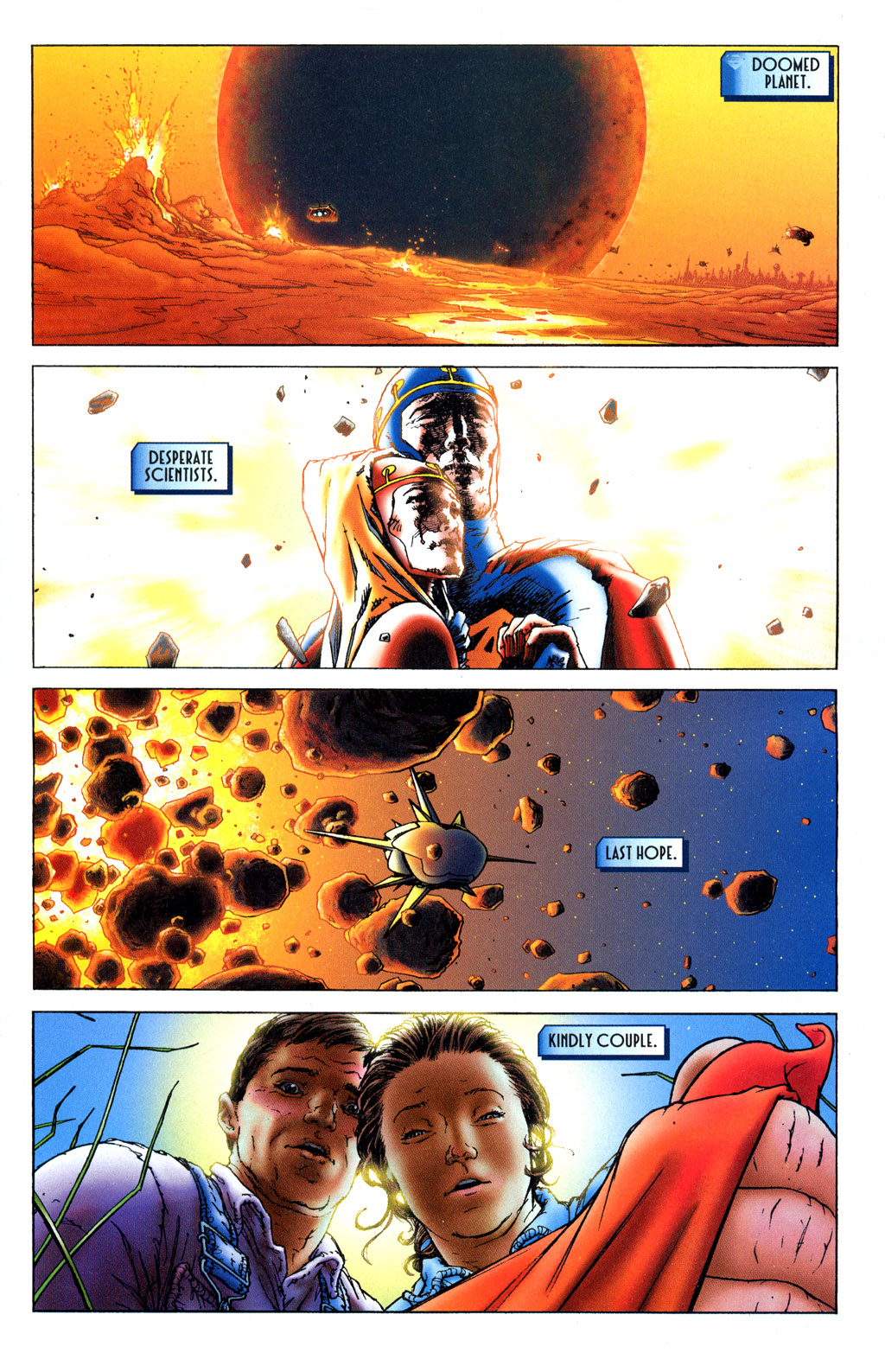
c) Just as an example of the bad scene construction, there's a scene where Clark finds an alien ship and he's about to stick his key into the ignition (basically), there's a robot protector behind him that he can't see. Oh no! Wait, what? See, it's shot as if we should be worried about what will happen to Clark, but (a) we don't know that the floating thing is a protector who will attack Clark; and (b) we don't know that putting in the key will turn off the robot. So basically we have a moment where Clark wants to do something, but what, why, and who opposes him?
cSub1) Which reminds me of another dumb move: when Zod's forces go to grab Kal's escape pod, one of them crashes into the barn to find it--and there it is. Did the Kents not try to hide it? As we learn when the evil Kryptonian leaves the barn, the escape pod was hidden in the basement. But by not showing us that first, the first impression is just that the Kents didn't hide the escape pod.
d) The big crisis for Clark seems to be whether he'll choose Krypton or Earth. Or maybe that's not the crisis, because, seriously, who expects Clark to choose to join with Zod--especially after Zod shows him the skull-strewn future? There's one moment where Zod tells Clark that he's destroying Krypton by destroying this one ship--and Clark does it, which seems like a big decision. And then the film goes on and on, with him having to fight Zod again to choose humans over Kryptonians. Blah. How many times are they going to make us watch dumb fights that all prove the same theme?
All that said, I want to highlight one moment at the end that I liked: when Clark comes to the Daily Planet as mild-mannered reporter, he meets Lois Lane, who knows his secret; and she gives a little smile and says, "Welcome to the planet." And that is just about the only humor in the whole movie.
Friday, May 2, 2014
Get Shorty vs. Wanted
By now I hope you'd have faith that I could use enough tortured logic to connect these two films: one, a mobbed-up showbiz comedy about a loan shark following the money when he really would rather be in the movie business; the other about a sad-sack office drone who discovers he's really one of the secret masters/caretakers of the world and then discovers that the group is really villainous. One is from a book by Elmore Leonard, one of the masters of the underworld comedy; the other is from a comic book written by Mark Miller, an author who has rapidly fallen down the hole of self-parody and empty spectacle at the best of times. (At the worst of times, his spectacle is actually reprehensible rather than empty.)
So, two radically different films that are connected by... the fact that I watched them both this week. Sure, we could notice other similarities and telling differences: both Chili Palmer (Get Shorty) and Wesley Gibson (Wanted) are people in new worlds, with Chili learning about the high life and low-lives of Hollywood and Wesley learning about the secret assassin conspiracy that keeps the world balanced. And maybe each has some bit of moral ambiguity, with bad people who might be good.
But really, what sets them apart is more interesting and more instructive. Get Shorty is fun and funny, with well-structured transitions between scenes; Wanted is an adenoidal mess, that revels in disconnected and dumb set-pieces--train crash, car flipping assassination, naked Angelina Jolie--rather than giving us any character or reason to care. The humor of Wanted is spiteful in those few scenes that could actually be said to be funny, which results in that oddest of combinations: the popcorn spectacle that takes itself too seriously.
And worse than all that: it's boring.
Part of that boredom is baked into the premise, if you're a nihilistic jerkoff: Wesley Gibson is a sad-sack loser who has to learn that he matters and also where he comes from--which means that his triumph looks a lot like beating up other people and getting awesome revenge, bro, because he matters. And so the movie moves predictably through the numbers: Wesley is victimized, Wesley learns the truth, Wesley won't take it anymore, blah blah blah. It's the cinematic equivalent of a toddler throwing a tantrum: I MATTER! Sure, fine, but you're not the only one.
Whereas Get Shorty particularly excels because everyone is given their moment in the spotlight. Sure, some people are dumb, some are venal, some are violent--but they all come across like real people. In fact, Chili Palmer's secret weapon is that he cares about people: he'll get a tip from a "widow" because he's a good guy, he'll get extra help from a stuntman-turned-enforcer-and-dad by treating him like a human being, etc.
So in a way, Chili Palmer succeeds for the same reason that Get Shorty succeeds: because he and it accepts that other people matter, too.
So, two radically different films that are connected by... the fact that I watched them both this week. Sure, we could notice other similarities and telling differences: both Chili Palmer (Get Shorty) and Wesley Gibson (Wanted) are people in new worlds, with Chili learning about the high life and low-lives of Hollywood and Wesley learning about the secret assassin conspiracy that keeps the world balanced. And maybe each has some bit of moral ambiguity, with bad people who might be good.
But really, what sets them apart is more interesting and more instructive. Get Shorty is fun and funny, with well-structured transitions between scenes; Wanted is an adenoidal mess, that revels in disconnected and dumb set-pieces--train crash, car flipping assassination, naked Angelina Jolie--rather than giving us any character or reason to care. The humor of Wanted is spiteful in those few scenes that could actually be said to be funny, which results in that oddest of combinations: the popcorn spectacle that takes itself too seriously.
And worse than all that: it's boring.
Part of that boredom is baked into the premise, if you're a nihilistic jerkoff: Wesley Gibson is a sad-sack loser who has to learn that he matters and also where he comes from--which means that his triumph looks a lot like beating up other people and getting awesome revenge, bro, because he matters. And so the movie moves predictably through the numbers: Wesley is victimized, Wesley learns the truth, Wesley won't take it anymore, blah blah blah. It's the cinematic equivalent of a toddler throwing a tantrum: I MATTER! Sure, fine, but you're not the only one.
Whereas Get Shorty particularly excels because everyone is given their moment in the spotlight. Sure, some people are dumb, some are venal, some are violent--but they all come across like real people. In fact, Chili Palmer's secret weapon is that he cares about people: he'll get a tip from a "widow" because he's a good guy, he'll get extra help from a stuntman-turned-enforcer-and-dad by treating him like a human being, etc.
So in a way, Chili Palmer succeeds for the same reason that Get Shorty succeeds: because he and it accepts that other people matter, too.
Friday, April 25, 2014
The good bits from World's End
The Pegg/Wright/Frost Three Flavours Cornetto trilogy all marry some big genre with some smaller personal story and comedy: zombies and growing up in Shaun of the Dead, buddy cop and odd couple in Hot Fuzz, and now, alien invasion and growing up in The World's End.
And maybe that's why the film doesn't seem to work all that much for me, despite it getting good reviews and having some fun moments: didn't they already do this film before? I mean, the alien/robot angle is just that--an angle, a trope, a premise. Thematically speaking, the idea of a crisis forcing a character to grow up isn't all that new to this crew.
There's some interesting and good bits to this movie, including the recognizable and almost anti-heroic protagonist in Gary King, an addict and nostalgia junkie who feels his best days are behind him and is willing to lie and trick his friends to get back to his self-centered vision of the ideal world.
There's also the opening section, where Gary's voice-over about the best drunken day is revealed as a support group; and his assembly of the team scenes, which all cut out right before the person agrees to go with his crazy plan because (a) they really have no reason to say "yes" and (b) it's unimaginable that they'd say "no" given the premise of the film. And each person asks about Andy, which builds up anticipation for Andy's recruitment--which is the only one we see the end of and the only reasonable end: this person has no reason to want to go back in time, since he's built an adult life for himself, so of course he says no.
The film also nicely balances--at the beginning--the weirdness of the situation and the discomfort of these ex-friends. So, right before Andy confronts Gary about a terrible lie Gary told, Gary discovers the alien/robot invasion; which distracts us from the interpersonal tension, but only for a moment, so now these guys have two problems to deal with.
And there is something thematically appropriate about these alien/robots--the "blanks"--being preserved forms of younger selves, since that's Gary's problem: he needs to let go of his younger self.
Yet, the film also has a very shaggy elements, not helped by the ensemble cast where we clearly aren't meant to care too much about anyone but Gary and Andy. By the time we get to the aliens who are part of a network, part of Starbucking (buying up places with local color and turning them into chains), it feels less like a coherent movie about the dangers of holding on to the past. After all, Gary's problem is that he hasn't changed, but the town of Newton Haven's problem is a mix of "not changed, still terrible" and "changed to become ordinary."
And while it's fun to see a large man like Nick Frost turned into an action hero, tearing through alien/robots, his hatred of the town isn't really explored or explained. In fact, the more I think about it, the less I understand the character of Andy, which is really a shame, as he's the one whose anger really drives much of the film.
And maybe that's why the film doesn't seem to work all that much for me, despite it getting good reviews and having some fun moments: didn't they already do this film before? I mean, the alien/robot angle is just that--an angle, a trope, a premise. Thematically speaking, the idea of a crisis forcing a character to grow up isn't all that new to this crew.
There's some interesting and good bits to this movie, including the recognizable and almost anti-heroic protagonist in Gary King, an addict and nostalgia junkie who feels his best days are behind him and is willing to lie and trick his friends to get back to his self-centered vision of the ideal world.
There's also the opening section, where Gary's voice-over about the best drunken day is revealed as a support group; and his assembly of the team scenes, which all cut out right before the person agrees to go with his crazy plan because (a) they really have no reason to say "yes" and (b) it's unimaginable that they'd say "no" given the premise of the film. And each person asks about Andy, which builds up anticipation for Andy's recruitment--which is the only one we see the end of and the only reasonable end: this person has no reason to want to go back in time, since he's built an adult life for himself, so of course he says no.
The film also nicely balances--at the beginning--the weirdness of the situation and the discomfort of these ex-friends. So, right before Andy confronts Gary about a terrible lie Gary told, Gary discovers the alien/robot invasion; which distracts us from the interpersonal tension, but only for a moment, so now these guys have two problems to deal with.
And there is something thematically appropriate about these alien/robots--the "blanks"--being preserved forms of younger selves, since that's Gary's problem: he needs to let go of his younger self.
Yet, the film also has a very shaggy elements, not helped by the ensemble cast where we clearly aren't meant to care too much about anyone but Gary and Andy. By the time we get to the aliens who are part of a network, part of Starbucking (buying up places with local color and turning them into chains), it feels less like a coherent movie about the dangers of holding on to the past. After all, Gary's problem is that he hasn't changed, but the town of Newton Haven's problem is a mix of "not changed, still terrible" and "changed to become ordinary."
And while it's fun to see a large man like Nick Frost turned into an action hero, tearing through alien/robots, his hatred of the town isn't really explored or explained. In fact, the more I think about it, the less I understand the character of Andy, which is really a shame, as he's the one whose anger really drives much of the film.
Monday, April 21, 2014
The Wild Bunch's flashbacks and other structural issues
Sam Peckinpah's The Wild Bunch is known as one of those late Westerns that shows the encroachment of the future--the running out of land and time for a bunch of old outlaws--and as a very violent film. It reminds me a lot of Blood Meridian on both counts: a revisionist Western where all our usual ideas are twisted by age and by the dirty reality of what these guys live through.
That said, and before I split the movie up into beats, I want to talk about two interesting things. First, you could easily tell this as the story of the outlaw leader; or of the ex-outlaw who is hunting the outlaw group. But Peckinpah cuts back and forth between Pike Bishop, aging outlaw with a tenuous grasp of his outlaw group and Deke Thornton, ex-range rover who has been co-opted by the railroad to hunt Bishop down. (I'm a little unclear, but it seems like Deke is working with the law to obtain pardon for his past misdeeds.)
Now, this doesn't make them co-protagonists: a film could easily show the protagonist running and then the antagonist chasing as a way to ramp up tension. And a film could parallel the two characters' journeys and stories: as here, both Pike and Deke are leading groups of unruly men, looking to get out of the game through one big score. Peckinpah also gives Pike and Deke both their own flashbacks, where we see some part of what motivates them: Deke's capture and terrible experience of jail, Pike's failure to settle down.
The film is also curious because with so many people, it might be hard to figure out who to look out or care about. Do we care about Pike or Deke? Do we care about Dutch or the German consultant? Or the Mexican general or etc., etc. The flashbacks help with that, as do some of the monologues: Pike and Deke are the only ones with flashbacks, the only ones working off some debt, the only ones whose ambitions we know about. So we know that Dutch wants to make money, but what for? We never really get a sense of what he considers the good life. So the flashbacks--which might be clumsy--help to focus our attention on what we should be watching.
Now, for the beats and scenes:
That said, and before I split the movie up into beats, I want to talk about two interesting things. First, you could easily tell this as the story of the outlaw leader; or of the ex-outlaw who is hunting the outlaw group. But Peckinpah cuts back and forth between Pike Bishop, aging outlaw with a tenuous grasp of his outlaw group and Deke Thornton, ex-range rover who has been co-opted by the railroad to hunt Bishop down. (I'm a little unclear, but it seems like Deke is working with the law to obtain pardon for his past misdeeds.)
Now, this doesn't make them co-protagonists: a film could easily show the protagonist running and then the antagonist chasing as a way to ramp up tension. And a film could parallel the two characters' journeys and stories: as here, both Pike and Deke are leading groups of unruly men, looking to get out of the game through one big score. Peckinpah also gives Pike and Deke both their own flashbacks, where we see some part of what motivates them: Deke's capture and terrible experience of jail, Pike's failure to settle down.
The film is also curious because with so many people, it might be hard to figure out who to look out or care about. Do we care about Pike or Deke? Do we care about Dutch or the German consultant? Or the Mexican general or etc., etc. The flashbacks help with that, as do some of the monologues: Pike and Deke are the only ones with flashbacks, the only ones working off some debt, the only ones whose ambitions we know about. So we know that Dutch wants to make money, but what for? We never really get a sense of what he considers the good life. So the flashbacks--which might be clumsy--help to focus our attention on what we should be watching.
Now, for the beats and scenes:
- Bank robbery: we meet Pike's group in the midst of a robbery (which is at least half a heist, as they've dressed in army uniforms as disguise); we meet Deke's posse trying to stop the robbery
- Aftermath: we see the posse being rather terrible bounty hunters, arguing over who killed whom and not caring about the town getting shot to hell; we also see Pike's team deal with the fact that their robbery is all scrap metal, not silver--which strains the group.
- The aftermath sequence is actually a few scenes, with Deke's men being terrible and the townsfolk yelling at the railroad man; Deke yelling at his men and the railroad man reminding him of the deal; and with Pike killing a wounded man and then the team resting at their rendezvous place
- Matched memories: Deke notes that Pike is the best and he knows since he rode with Pike; Pike remembers how Deke got caught and he didn't; Pike comments on the old feller (Sykes) who sticks around them.
- Trouble and triumph on the trail: There's some hard travels and Pike is getting older. But he gives a speech that keeps them together, all the way to Mexico, where fellow robber Angel's village gives them a warm welcome--even though they've got problems: the crooked federales, led by Mapache, who lured away Angel's sweetheart.
- The general, the deal: Which brings us to Mapache, the general who needs good American rifles to defeat Pancho Villa, and who agrees to pay Pike a great deal of money. These scene ends well for the Americans, though it begins with danger as Angel confronts his sweetheart and then shoots her. Which brings us to a big party scene and a discussion of what they'll do with the money--and how much Angel hates Mapache, which launches the plan to give Angel's people one of the cases of guns.
- The hunter: We get some info on Deke and his hunters, who suspect Pike of trying to rob the very train full of guns that we know Pike will rob. Ruh-roh.
- The robbery: another fun heist/shootout as Pike robs the train, Deke's posse chases, and the green US Army chases them.
- Mapache's problem: We see Pancho Villa's men kick the hell out of Mapache, which reminds us that he needs the guns.
- The two gun transfer problem: Pike gives guns to Angel's friends. To make sure they get paid, Pike's men first wire up the guns to explode, then plan to transfer them in small shipments, while getting paid each time. The only problem is that Angel is fingered as the guy who stole the missing shipment of guns--the mother of the woman he killed told on him. So Mapache takes him.
- Deke on the trail: Pike doesn't want to go rescue Angel, but with Deke men on their trail, he decides to go visit the general for save haven. (One of Deke's men shoots Sykes in the leg; wounded Sykes eventually is found by an Indian.)
- Disgusting party: Just as we had a party at 5, we see Mapache celebrate his guns, and also celebrating by torturing Angel. Pike doesn't like it, but can't do anything.
- On Deke's trail: meanwhile, Deke is being hunted by US Army, since some of his men shot at them in 7. His only hope is to take down Pike.
- Endgame: Next morning, Pike is disgusted with himself and gathers his men to take back Angel, which leads to the massacre when Mapache slits Angel's throat and they shoot Mapache and then the German consultant.
- Notable: Deke looks on as Pike and the federales fight it out.
- Pike shoots a woman, reminiscent of his memory of his lover getting shot by her husband.
- Pike gets shot by a child soldier.
- Deke's reckoning: Deke's posse comes on the scene, acting as loutish as usual; Deke grabs Pike's gun and decides to stay behind. He runs into Sykes and the Indians who offer him a place: "It ain't like it used to be, but it'll do."
Friday, April 18, 2014
Captain America 2, fourth (and hopefully final) thoughts
As an action film, Captain America 2 was... OK. This is really the make-or-break aspect for a film like this. (That and box office--and I think the film is doing fine at the box office. We saw it on opening day at 2:40 and the theater was pretty packed, though not sold out.) And it delivers on a few scales. Let's try to break this down (because I love breaking things down. Not such a fan of putting things together afterward. Oh well).
Was the action exciting as action? Sure. It was fun to see an old-fashioned car chase and a brawl in an elevator and so on. I especially thought it was smart to keep the action sort of low-key: when it's just Captain punching a guy, we don't wonder why they don't call in Thor and everyone else on the Avengers. That said, my girlfriend thought that some of the action scenes went on a little long, and I have to agree, because--
Was the action exciting as story? Not really always. In fact, the action almost always was spectacle that didn't move the story forward and had no more narrative weight than "Will Captain defeat his enemy?" The most interesting fight scene occurred with the Winter Soldier, but almost everything else was clearing the level to get to the boss. And when the fight is between Black Widow and Robert Redford, well, la, you'll excuse me for checking my watch. (In fact, I keep thinking how much more awesome and fun it would've been if the SHIELD council had actually done something to save themselves. No offense, but in a film where we see how fallible the institution is, what sort of message does it send to make us normal people wait for the superheroes to save us?)
Was there anything that slowed down the action? For me, the film has a lot of "people staring out windows giving big speeches" moments. It might only have two of those scenes, but they stick out like a sore thumb to me. When there's nothing happening on the screen and all the info is being delivered verbally, I feel like we might as well have a flashing light declaring this "Theme discussion" or "Background exposition." In a film that has a bunch of clever and well-done scenes, these few hiccups stick out.
Uh, well, I thought I had more issues to break down, but now I'm not so sure. So, after all those posts, I would probably sum up Captain America 2 by saying that it was mistitled in the subtitle: the Winter Soldier is such a minor part of the story, though he is the best and most interesting. It was fun, but not as exhilarating as the first Captain America. And not as topical and interesting as it could be.
Was the action exciting as action? Sure. It was fun to see an old-fashioned car chase and a brawl in an elevator and so on. I especially thought it was smart to keep the action sort of low-key: when it's just Captain punching a guy, we don't wonder why they don't call in Thor and everyone else on the Avengers. That said, my girlfriend thought that some of the action scenes went on a little long, and I have to agree, because--
Was the action exciting as story? Not really always. In fact, the action almost always was spectacle that didn't move the story forward and had no more narrative weight than "Will Captain defeat his enemy?" The most interesting fight scene occurred with the Winter Soldier, but almost everything else was clearing the level to get to the boss. And when the fight is between Black Widow and Robert Redford, well, la, you'll excuse me for checking my watch. (In fact, I keep thinking how much more awesome and fun it would've been if the SHIELD council had actually done something to save themselves. No offense, but in a film where we see how fallible the institution is, what sort of message does it send to make us normal people wait for the superheroes to save us?)
Was there anything that slowed down the action? For me, the film has a lot of "people staring out windows giving big speeches" moments. It might only have two of those scenes, but they stick out like a sore thumb to me. When there's nothing happening on the screen and all the info is being delivered verbally, I feel like we might as well have a flashing light declaring this "Theme discussion" or "Background exposition." In a film that has a bunch of clever and well-done scenes, these few hiccups stick out.
Uh, well, I thought I had more issues to break down, but now I'm not so sure. So, after all those posts, I would probably sum up Captain America 2 by saying that it was mistitled in the subtitle: the Winter Soldier is such a minor part of the story, though he is the best and most interesting. It was fun, but not as exhilarating as the first Captain America. And not as topical and interesting as it could be.
Wednesday, April 16, 2014
Captain America 2, third thoughts
Previously on this blog:
In a way, the last was the most disappointing. Learning that SHIELD was actually sheltering a secret cabal of Hydra deflected all of the serious ethical issues that we have. Which is fine for an action movie--maybe in a movie about a super-soldier who always does the right thing, you don't want to say "sometimes our military-security complex makes the wrong decision." But the way that this film puts all the blame on Hydra makes the moral issues more melodrama than drama. Particularly in a movie featuring lots of shoot-outs in crowded areas, this "the bad guys do bad things, the good guys are always good" morality rang as hollowly as a fist on Captain's shield.
So, Captain America 2 was a serious film when it looked at Steve Rogers's sadness and out-of-time quality; but it undercut that when it portrayed his enemies as completely evil and (worse) dumb. So, how was it as an action film?
- Everyone seems to love Captain America 2.
- It hits Captain's melancholy hard.
- It doesn't really play with paranoia, political thrills, or surprise in any meaningful way.
- It doesn't really have anything serious to say about contemporary issues.
In a way, the last was the most disappointing. Learning that SHIELD was actually sheltering a secret cabal of Hydra deflected all of the serious ethical issues that we have. Which is fine for an action movie--maybe in a movie about a super-soldier who always does the right thing, you don't want to say "sometimes our military-security complex makes the wrong decision." But the way that this film puts all the blame on Hydra makes the moral issues more melodrama than drama. Particularly in a movie featuring lots of shoot-outs in crowded areas, this "the bad guys do bad things, the good guys are always good" morality rang as hollowly as a fist on Captain's shield.
So, Captain America 2 was a serious film when it looked at Steve Rogers's sadness and out-of-time quality; but it undercut that when it portrayed his enemies as completely evil and (worse) dumb. So, how was it as an action film?
Monday, April 14, 2014
Captain America 2, second thoughts
Captain America 2 takes Captain America, removes his clear enemies (Nazis, Hydra, Chitauri), and emphasizes how he's all alone, out of his own time. (The Avengers did the out-of-time shtick more superficially and amusingly, emphasizing that Steve Rogers doesn't know popular movies or that he's the subject of collectible cards.) This ramps up the uncertainty... or at least it should.
But when a film casts Robert Redford as a previously unknown but powerful character, and when we suspect that someone is really a traitor, it's like when Law & Order has a famous person: we know who the bad guy is. Similarly, when Captain America is alone romantically and ends up kissing Scarlett Johansson, I don't really wonder if maybe they'll become an item; or when Captain America attempts to reform his friend-turned-brainwashed killer, there's not much anxiety about whether it'll work.
So while Captain America 2 poses itself as something of a paranoiac political thriller, dealing with contemporary issues of the security state and over-surveillance and big data, it doesn't really land any of those punches. Critics and friends lauded that commentary on contemporary issues, but it felt pretty flat to me: "How much is security worth?" is an interesting question. "Can we morally kill an innocent if our big data analysis says this person will be a problem?" is a less interesting question. "Can we sacrifice freedom if it insures security--and, oh yeah, Hydra will be in charge?" isn't even a question at all--it's a call to arms.
Part of the failure of this film for me is encapsulated in the hostile takeover of SHIELD headquarters during the launch of the three new super-helicarriers: if your super-secret society is a few minutes away from taking over control through manipulation and subterfuge, why bring out the guys with the guns? Instead of ramping up tension, all that does is replace uncertainty with certainty. Which turns paranoia into a boxing match and clears up any problems that Captain had. After all, more than friends, Captain America needs a clear enemy.
But when a film casts Robert Redford as a previously unknown but powerful character, and when we suspect that someone is really a traitor, it's like when Law & Order has a famous person: we know who the bad guy is. Similarly, when Captain America is alone romantically and ends up kissing Scarlett Johansson, I don't really wonder if maybe they'll become an item; or when Captain America attempts to reform his friend-turned-brainwashed killer, there's not much anxiety about whether it'll work.
So while Captain America 2 poses itself as something of a paranoiac political thriller, dealing with contemporary issues of the security state and over-surveillance and big data, it doesn't really land any of those punches. Critics and friends lauded that commentary on contemporary issues, but it felt pretty flat to me: "How much is security worth?" is an interesting question. "Can we morally kill an innocent if our big data analysis says this person will be a problem?" is a less interesting question. "Can we sacrifice freedom if it insures security--and, oh yeah, Hydra will be in charge?" isn't even a question at all--it's a call to arms.
Part of the failure of this film for me is encapsulated in the hostile takeover of SHIELD headquarters during the launch of the three new super-helicarriers: if your super-secret society is a few minutes away from taking over control through manipulation and subterfuge, why bring out the guys with the guns? Instead of ramping up tension, all that does is replace uncertainty with certainty. Which turns paranoia into a boxing match and clears up any problems that Captain had. After all, more than friends, Captain America needs a clear enemy.
Subscribe to:
Posts (Atom)